One of the most common complaints I hear among intelligent believers is that atheists attack “straw men”. They accuse atheists of attacking the low hanging fruit of fundamentalist religion and biblical literalism while ignoring nuanced and sophisticated beliefs held by more intelligent theists. God, they suggest, is nothing like the God of the Bible, but it is something akin to energy, or a sense of awe, or attack, or poetry. Karen Armstrong, in her book “The Case for God” claims God is not a being, but God “is Being itself” and insists religion is not about belief at all, but practice. Christopher Hedges, author of “I don’t believe in Atheists” insists “that God is not a noun, but a verb”. He then says “God is the life force that sustains, transforms and defines all existence” (which actually does sound like a noun). Reza Aslan, the author of “No God but God” says “ironically, the new atheists take the bible but literally than most believers”
These critics have a point: Atheists may be free to attack fundamentalists, but if they want to attack theism more broadly, they ought to address it in all forms – including the more nuanced of belief. To do that, we need to look at how theism has evolved over time. We must understand how believers arrived at such vague and nuanced definitions of God. So let’s start at the beginning.
A History of Theism
In the 7000 years of recorded history, humans have documented, in writing, well over 10,000 gods. Most of these were minor deities, such as Nunbarsegunu, the Mesopotamian goddess of barley, but hundreds, like Anu, Enki, Marduk and Ra, were considered all powerful creators of the Universe. Today, these gods warrant only a footnote in history books, but in their time, evidence suggests people worshiped them with equal or greater devotion than most modern theists display today. They built temples in their names. We have records of prayers written to them and songs written for them. People celebrated holidays for their virtue, and sacrifices, animal and sometimes human, were presented upon altars to better gain their favor or avoid their wrath.
The obvious question: Where did they all go? How did they fall out of favor? We should suspect the success and longevity of any particular God to be highly correlated with the success and longevity of a tribe or nation of worshipers. For instance, Ra, the sun god, affiliated with the mighty Egyptian empire, survived for over 2000 years, the population of his worshipers expanding and contracting along with the borders of the Egyptian empire.
It is often the case throughout history that newly conquered cultures were converted to a new religion under threat of death or dismemberment, but other times the process was more organic, allowing a gradual shift of allegiances between gods. In this way, gods were forced to compete in a sort of marketplace of ideas where a sort of “survival of the fittest” was always taking place. Gods were constantly mutating and adapting, absorbing characteristics that drew believers into the fold and shedding ones that repelled them.
In ancient history, most gods possessed characteristics remarkably similar to humans. They fought, had sex, had terrible tempers, and even killed one another from time to time. The stories of their lives were, in many respects, analogues to today’s television soap operas — salacious stories have always had the ability to draw eyes and ears.
But for any god to be successful, one trait was desirable above all others: Power. A God needed to control something humans could not. This was ultimately their allure, for it was thought that by gaining the god’s favor, one could reap reward (crops, children, vanquishing of foes on the battlefield) and avoid their wrath. (floods, disease, etc..)
Robert Wright, author of “The Evolution of God” points out that the primary purpose of early Gods was to dispense favors and dole out punishment.
Just how to go about gaining this favor of the gods was surprisingly arbitrary. The reasoning often stemmed from a superstitious mistake linking cause and effect when it wasn’t warranted. For instance, a villager may melt honeycomb an hour before a rainstorm and assume the two are related. This may lead to the general idea that there is a deity in the sky that loves honey.
Of course, this opinion is equally likely to be forwarded by a holy man who loves honey, as the holy men were the typical recipients of gifts left on the altar. This ability for priests, chiefs and kings to alter the edicts of religions meant that early gods often reflected the will and desire of the leaders of any given society – from their noblest intentions to their most depraved indulgences. Throughout human history, gods were not only used to enforce laws against stealing, lying and murder, but also to justify genocides, rape, multiple wives, absolute rule, and slavery.
Given this wide variety of behavior, it’s easy to see how some gods could become more popular than others and as the population of the Middle East began to expand, three Gods in particular rose to prominence. El, Baal and Yahweh (Spelled YHWH in Hebrew bible). In the next few thousand years, the first two would be relegated to the dustbin of history with the thousands of other gods of antiquity, but Yahweh would become known as the God of Abraham, the God of the Hebrew Bible and ultimately, the god of Judaism, Christianity and Islam. Yahweh would eventually come to be worshiped by over 3 billion people — half the population of the Earth. His worshipers would become so ubiquitous his name would no longer be necessary. Today, Yahweh is simply known to those in the West as “God”, and “Allah” in the Middle East.
From Yahweh to God
Many Christians go their entire lives without ever knowing the god they pray to ever had a name, but by Charles Ryrie’s count, the name appears 6,823 times in the original Hebrew Bible (what Christians refer to as the Old Testament.) It was not until later that the name was replaced with “My Lord” or “God” to reflect a more universal nature. It was Yahweh that spoke to Noah, commanded Moses on the mountain top, gave us the 10 commandments and was the subject of Jesus and, later, Mohammed’s preaching.
Considering Yahweh is now worshiped as the sole God by roughly half the population on Earth, his origins were surprisingly humble – in fact, they are almost indistinguishable from that of hundreds of other Gods before him. He is at times, described as a son of El, but many scholars believe he likely merged with El at some time. In fact, some believe Yahweh assumed not only El’s position atop the pantheon of gods, but for a brief time, also assumed his wife (or consort) Asherea. His early personality, as recorded in the Hebrew Bible, was quite similar to other gods: He rewarded and punished his subjects on Earth – routinely smiting entire cities, causing floods and demanding sacrifices. Here’s how Richard Dawkins describes the God of the old Testament:
The God of the Old Testament is arguably the most unpleasant character in all fiction: jealous and proud of it; a petty, unjust, unforgiving control-freak; a vindictive, bloodthirsty ethnic cleanser; a misogynistic, homophobic, racist, infanticidal, genocidal, filicidal, pestilential, megalomaniacal, sadomasochistic, capriciously malevolent bully
How is it that Yahweh thrived to become the “one and only” god of the West while others faded away? Scholars cite many reasons, but we can begin with the obvious. The early Jews made a deliberate conscious effort to establish Yahweh as the one and only God. This was, in many respects, monotheism by design.
Consider; the very first of the 10 commandments forbids the worship of other gods. The 2nd suggests his name is too sacred to be uttered in vain. This gradual removal of Yahweh’s name from common speech was an essential step on the path to monotheism, for the very idea that God needs a name to discern himself from others implies other gods exist. The 3rd commandment eradicates the depiction of gods in physical statues or totems. This not only outlaws the Pagan gods, but suggests that Yaweh, himself, was too vast and all encompassing to be depicted in physical form. As Robert Wright points out in his book, the Evolution of God: Three of the 10 commandments – almost a full third of the ethical laws of society were deliberate steps to assimilate the masses into a sort of monotheism.
Another reason scholars give us for Yahweh’s eventual domination lies in Constantine’s conversion to Christianity in 312 A.D. As we previously stated, the reign of any particular God is highly correlated with the reign of the society that held it dear, and the Roman empire was the largest society the world had ever seen. Perhaps more importantly, it grew at a time when the world was becoming smaller. In the ancient world, relative cultural isolation allowed hundreds of religions to flourish without conflict, but as Rome spread, increasing cross-cultural communication and migration allowed for – even demanded — a more universal belief. That it would be something other than what Rome had sanctioned seems unthinkable.
And yet still, these answers do not entirely satisfy. They show us how Yahweh became the God of the Western world, but not why. Why did Constantine adopt Christianity? How did the idea spread so easily? What was Yahweh’s allure? History suggests that no religious idea can be forcibly thrust upon society for any length of time. In order for Yahweh to become the one and only God, the masses must have willingly accepted him, and to do that he’d need a universally palatable message – one that would “ring true” in the hearts and minds of the average citizen of the world. It appears he found that via Jesus of Nazareth and Paul the Apostle. The message was that of love and forgiveness:
“Do to others as you would have them do to you. (Luke 6:31)
“Love one another. As I have loved you: (John 13:34-35)
“’Love your neighbor as yourself.” (Mathew 22:39)
This message had legs. We see its appeal grow and strengthen throughout the Gospels. In Mark (thought by scholars to be the first, or earliest Gospel written some 65 years after the death of Jesus), we hear multiple sermons suggesting God wants humans to love one another, but things take a subtle shift by the time we Gospel of John (thought by scholars to be the last, or latest written, some 30 years after the gospel of Mark) Here God is not only urging us to love one another, but God becomes love.
The one who does not love does not know God, for God is love (John 4:8)
And so we know and rely on the love God has for us. God is love. Whoever lives in love lives in God, and God in them. (John (4.16)
This subtle change in definition over the course of a generation had profound implications. No longer was Yahweh an invisible being in the sky – no different from the 1000s of gods that preceded him – incapable of withstanding the slightest scientific scrutiny, but he became love — a feeling in our hearts: something universally experienced by all humans. In effect, he became something real. For there’s a key difference between a God that commands us to love one another and a God that actually IS love. Namely, the former doesn’t exist, the latter actually does – no one can suggest love itself does not exist.
Love is just difficult enough to understand to warrant supernatural explanation, but altogether real enough for its existence to be undeniable. It’s so beautiful as to inspire spirited songs and poetry and yet sometimes so difficult to embrace, that it requires strict discipline. Furthermore, following a life based on love is, in fact, rewarding. Rejecting love does, in fact, ultimately lead to sorrow. These are truths that “ring true” in the hearts of everyone, regardless of the culture in which they were raised.
So Yaweh became something real. Zeus, Bal, Ra, and thousands of other gods faded into history, while Christianity (and eventually Islam) spread through the Middle East and Europe. Other gods might preach love, but few could compete with actually being love. The race was over and the strongest idea survived. The god of Abraham had won the West. He was no longer Yahweh, he would be known as simply “God”.
Contemporary Monotheism
What does the thinking believer make of all this? Given that Yahweh’s origins were largely indistinguishable from 1000s of other gods, they now face a serious question. How can they defend the veracity of the claim that Yahweh is the one true god while dismissing all others?
There are many possible answers, but only one warrants exploration, and it leads us to the more modern, nuanced view of God held by contemporary theologians. Most modern theologians believe there is and always has been only God. His (or hers, or its) presence is universally felt (or inferred) by everyone, and all of the gods of antiquity (including Yahweh) are but clumsy, rudimentary attempts to define this presence in some anthropomorphic manner. The modern theologian believes God was, and always has been, love. It just took humans a while to realize it.
Survival of the fittest is a ruthless process. Selfishness is the engine that drives it. There are no rules. If you want to get ahead by eating another organism, more power to you. In fact, many species (all carnivores) have evolved whose only means of survival is the terrorizing, torture and consumption of perfectly innocent sentient animals. Evolution relies on the cold, hard facts of getting our genes to the next generation by any means necessary.
So perhaps the most difficult question an atheist must answer is “Why do we love?”
Theologians have always dealt with the “The problem of Evil ”: If God truly is all powerful (omnipotent), all knowing (omniscient) and all good (omnibenevolent), why does he let evil and suffering exist?
Scientists must deal with “The problem of Good”: If evolution is a cold and ruthless process that relies on survival of the fittest. How did humans evolve the impulse to love?
How did all this selfishness create selflessness?!
To answer this question, let us first classify different types of love. Philosophers, theologians and writers have classified the love in many different ways, but scientists have divided the impulse into three:
Love for Family (Children, Brothers, Sisters, Cousins… all blood relations)
Love for mates (Everything from a one night stand to a life mate.)
Love for friends, acquaintances and strangers.
These are listed in order it’s believed they evolved. Evolution is economical, and will make full use of existing structures and mechanisms in the brain by amending, parsing and expanding upon them. So it’s unlikely altruism, or a kindness to strangers would evolve without the mechanisms for affection and goodwill toward family members already in place.
Let’s start with number one:
Love for Family
It’s quite clear that a mother cow who ate her offspring would not be evolutionary successful. A mother that ignored her calves would fare slightly better, but a mother that tended to her calf’s needs would fare best of all. Thus, emotions that strengthened a cow’s affection for her offspring (and hence more nurturing) were more likely to evolve than those that fostered indifference or contempt. The well nurtured calf would possess the very genes that caused its mother to dote and subsequently treat its own young with similar affection – or possibly more given random mutation. As long as the gene (or mutations of it) were beneficial, it would continue to spread through the population. So the next time your mother is obsessively doting on you, thank a million years of mammalian evolution.
This love between mother and child is part of a larger theory called “Kin Selection”.
The theory of kin selection states some animals will help their relatives, even if it is at a cost to their own survival and or reproductive success, as long as the benefit to their own genes within their relatives is greater than the cost the genes in themselves incur. It explains the why bees give up their lives stinging predators for the good of the hive, why squirrels stand up and chirp warning calls to their family if a hawk is circling, despite the obvious disadvantage of drawing attention to oneself and why wolves regurgitate perfectly good meals so their pups can eat.
John Maynard Smith coined the term “Kin Selection” in 1964, although he was expanding on the concepts brought into academia by R.A Fisher in 1930, J.B.S. Haldane in 1955 and W.D. Hamilton in 1963.
The basic revelation that allowed for kin selection was the idea that gene, not the organism was the basic unit of evolution. That is to say, the phrase “survival of the fittest” does not necessarily refer to organisms, but rather individual genes. The gene that makes the most copies of itself will proliferate. In this new paradigm, humans become the mere vehicles for gene’s transmission to the next generation. It’s not a particularly flattering role, but science pretty much tossed flattery out the window when we realized we merely very smart apes.
To allow ourselves to see things from the gene’s point of view (if it had one, which it doesn’t) let us examine the cold virus. Viruses are not alive in that they cannot reproduce without a living cell. But they do have genes and they do evolve. When a cold virus attacks, humans begin producing massive amounts of mucus accompanied by fits of coughing and sneezing. This is a natural defensive response that is thought to help remove the virus from the body. However, it’s been shown that people who skip the drugs to suppress coughing, sneezing and mucus production tend to get well as quickly as those who take them.
So why do we have to blow our nose every thirty seconds when we are sick if it’s not particularly helping us? To answer this question, we need to look at the situation from the virus’s point of view. As it turns out, sneezing and producing mucus is a marvelous way to spread from human to human, particularly in the EEA where there were no Kleenexes or hand sanitizer. Thus, cold viruses that triggered a massive overproduction of mucus and sneezing in their hosts were more apt to spread and reproduce.
Something similar is going on with our genes. Every single gene in our body is on its own path of evolution. As far as it’s concerned (if it had concerns, which it doesn’t) we are merely a host. In this respect, the gene is “selfish”. (This is the correct interpretation of the impossibly misleading title of Richard Dawkins’ seminal work, “The Selfish Gene” )
So if gene XYZ causes us to feel great affection toward other organisms that likely possess gene XYZ, it will likely spread throughout the gene pool.
This is particularly true amongst the social insects. Many bee hives or ant colonies are filled individuals that are near clones of one another. This is why bees or ants routinely give their lives for the benefit of the colony, because the genes that die in that one individual are present in thousands of others.
But of course, human relatives are not clones. On average, parents share 50 percent of their genetic material with their offspring. Siblings share 50 percent. First cousins and Aunts share 25 percent, 2nd cousins, 12.5% and so on. So it only makes sense that whatever gene caused affection toward relatives would become weaker as relatedness diminished.
This phenomenon led J.B.S. Haldane famously remarked that he’d lay down his life for “two brothers, or eight cousins.” He was joking of course, but there is a deeper truth behind his levity; we do, on average, tend to develop closer relations with our closest relatives. Even in families that seem to constantly fight with one another, when the chips are down, they are more likely to depend on each other than they are on outsiders.
When we add reproductive potential to the mix, things get even more complex. While you share 50 percent of your genes with your parents, they are more likely to grant you favor than you are to them. Why? Because you have more reproductive potential. You can carry the genes into the next generation. This is not to say that we don’t care for our elders, but it is a different sort of love (that we will get to later).
Of course, all this is subconscious. Ants are not thinking of the good of the colony when they give their lives, they are doing what comes naturally. Humans aren’t scribbling down math equations to determine what percentage of our genes we share with our nephew when we try to decide whether or not to help put him through college. Evolution has taken care of the math for us, and spits out the answers in terms of our emotional response. We are just doing what comes naturally to us.
Of course, a mother’s subconscious concern for her own genes begins long before her child’s birth, in fact, long before conception. When a female of any species is deciding on a male suitor for reproduction (all of whom are eager to get their genes inside her womb) she is subconsciously evaluating the quality of those genes that will intermingle with her own. And if she is from a species whose offspring benefit from a two parent “household”, she is also evaluating the loyalty of the prospective mates… This is where our second type of love comes into play.
Love for Mate
This is romantic love. This is what inspires poems. Not surprisingly it has evolved to be most intense around the time we are most fertile, from our late teens to mid adulthood. This is not by design, at least not by intelligent design. It is simply because genes that intensified romantic love in our most fertile years were more successful than those that intensified love in childhood or old age.
The first and most obvious benefit of romantic love is that it leads to sex; the keystone of evolution. The dance between the male and female and the courting process is perhaps the most interesting part of evolutionary psychology. But there is lust and there is love – the two are often intertwined in passion – however, it’s quite possible to draw distinctions between the two. The first gets us to mating, but it’s the latter that keeps us together. The interplay between these two emotions creates the stuff of drama, played out on stage and screen.
Why would evolution select for romantic love that keeps us together long after mating? Because having sex is of no use if the offspring don’t survive, and in many species, the odds of survival are greatly increased if the father sticks around. Psychologists call this “Male Parental Involvement” and there’s no more effective way to get the father to stick around than to parley his lust for his mate into something deeper – true love. It’s a phenomenon not just limited to humans, but to any animal that needs two parents. Birds for instance, typically need one parent to sit on the eggs and the other to gather food, so as we might expect, the vast majority of species of birds (some 90 percent) are monogamous (Although DNA analysis of the eggs in the nest shows they are also quite prone to having secret affairs).
Parrots, in the absence of other birds, will even pair bond with their owners and exhibit intense jealousy for their attention. There are few things stranger than being in a love triangle with a bird, but ask any married couple that owns a parrot and they’ll tell you exactly what it’s like.
Other species, such as hoofed mammals, tend to have offspring that can walk in seconds, and run in minutes. There is almost no benefit to having two parents, and predictably, monogamy just isn’t in the cards for antelope, buffalo or zebras (among others). These animals are polygamous. The females of these species are interested in one thing – good genes. A good way to find out who has the best genes is to let the males fight over mating rights, this way, the largest and strongest male will win. This is the alpha male, and he generally mates with whom he pleases. But once again, affairs are common, and mating will take place out of sight of the alpha male. In fact, amongst intelligent social animals, like baboons, it’s typically so difficult for the alpha male to keep an eye on everything that he usually builds an alliance with a few rough and tumble cohorts and gives them limited mating rights as well as reward for their loyalty.
The fact that males of polygamous species fight for mating rights accounts for their larger size. In fact, size differential between males and females of any given species is a fairly good correlate to the degree of polygamy in that species. For instance, male gorillas are nearly twice the size of female gorillas and they are largely polygamous. Male and female gibbons are roughly the same size and they are entirely monogamous. Humans, interestingly enough, rest somewhere in between Gorillas and Gibbons. Not polygamous, but not quite monogamous either.
This might come as some surprise considering the vast majority of present human societies are monogamous. Of course it hasn’t always been this way; the history of the world is rife with polygamy. That we’ve settled into monogamy as wealth becomes more equally distributed and democratic power spreads around the world is not surprising. Not only do women have more say in whom they marry, but polygamous cultures suffer from stability problems: It’s just not healthy for society to have that many young, unmarried men loitering about, unable to get a woman of their own since they’ve all been hoarded by the wealthy elite. Thus, in our present society, when a wealthy man wants another wife, he must first divorce his current one. The same is true when a marketable woman finds herself with a shiftless husband. This sort of “serial monogamy” has become the de facto standard amongst western cultures.
Altruism
It’s fairly easy to see how evolution has instilled such traits as trust, love and affection for kin and mates into our emotional psyche, but most religion talks about a deeper, more powerful love: The love for your neighbors, the love for strangers, even the love for your enemy exemplified in the story of the Good Samaritan. We call it Altruism, and, at first glance, it seems to be a striking counter example to the very idea that natural selection can account for everything. If the very engine of “survival of the fittest” is self- interest, how can this engine spawn generosity? It seems intuitively backwards. How does selflessness arise from selfishness?
It helped that the foundation for good behavior had already been laid in our brain. Kin selection and Mate Selection provided the mechanisms for love, trust and affection. All that was required was the extension of this love and trust to those in the village who shared no obvious relation. But the question still remains, why would such an extension be beneficial to us? How could it possibly be to our advantage to spend time and energy helping- others that were not related to us?
One early theory focused on “Group Selectionism”. It stated that villages composed of people who cooperated and who were kind to one another were more likely to thrive than villages that were always fighting. Villages that cooperated did especially well, if they banded together and attacked their disorganized neighbors. This is certainly true, and this theory could even be stretched to suggest that the increased interdependence of all nations today is creating a “global village” atmosphere that could account for our improving moral sense. In today’s “smaller” world, our actions in one corner of the globe do not escape the scrutiny of all, and can have retributions in our own corner. We’re starting to see everyone as part of “our” group. Robert Wright has written an entire book that describes this scenario. In it, he suggests that even if your thinking is wholly selfish, it doesn’t make sense to bomb your neighboring country when your food is grown there and they provide a market for your goods.
But this theory presents us with a sort of “Chicken and Egg” problem. For mutations don’t occur to everyone in a group simultaneously, they happen to one organism at a time. So the very first organism whose genes give him or her some proclivity to extend trust and affection to strangers, will be like a dove in the midst of hawks. They will be exploited and will never obtain a survival advantage and thus the gene will never spread throughout the population. This is why “group selectionism” doesn’t provide a complete explanation of the genesis of true altruism. It may help it along once it gains a foothold, but it cannot account for the origin. In order for the tendency for altruistic behavior to evolve it has to be immediately beneficial. What does the giver have to gain?
Thankfully, humans knew the answer long before they were human because the genes for being kind to kin had already evolved. Families proved the power of cooperation. The phenomenon is so powerful in fact, that those organisms that tentatively extended their helping hands and affection beyond the family began to fare better than those that did not. Simply put, in any species where cooperation aids survival, organisms that make friends with strangers tend to fare better than ones that make enemies.
It’s called reciprocal altruism. A sort of “you scratch my back and I scratch yours” relationship we have with our neighbors, whether it be sharing food, shelter, information, or actually scratching their back.
Now, most spiritual people are quick to point out that being truly moral and virtuous means doing things without expectation of reciprocation. We’re going to get to that. We have to build this “moral sense” one block at a time, and it’s fairly well accepted that this is how it began: Kin Selection created the mechanisms for love and affection and the benefits of reciprocal altruism allowed us to extend these feelings to strangers. All the while, the fact that mammals often keep family in close proximity provided a “buffer” of sorts that let a “dove” gene flourish away from the exploiting hawks. After all, there’s not much harm in a “be nice to everyone” gene if everyone around you happens to be a blood relative. This allows the gene to evolve covertly, benefiting carriers in the same manner of kin selection for quite some time. As generations pass even those so distantly related to you so as to not warrant the “family” treatment might very well have some of the genes responsible for the impulse of reciprocal altruism that you do. This is when it becomes immensely powerful. For when a dove meets another dove, cooperation ensues, and two humans can do exponentially more than one.
Non-Zero
In fact, it’s almost as if something magical happens when two people cooperate. Evolutionary psychologists call the phenomenon, “Non-Zero” sumness.
A zero-sum game occurs when one person’s gain equals another’s loss. For instance, if there is one apple left and you and I are fighting for it, every bite of the apple I take is one you can’t have, and vice versa. My gain equals your loss, so together we will always equal zero.
A non-zero sum game is one where two people can create a win-win relationship. The simplest example might be two people pushing a boulder up a hill that neither could push up alone. Or hoisting the wall to a cabin that requires more than one person. It pays us both to cooperate. Likewise, if 10 villagers go hunting every day, but each one only has a 10% chance of capturing a deer or buffalo on any given day, they would do well to enter into an agreement to share the meat from each day’s catch. This way, everyone will likely have fresh meat every day.
In Zero-Sum interactions there can be only one winner. In non-zero sum interactions, both parties can come out ahead via cooperation. And for humans, non-zero interactions are the de facto standard. This is why we tend to live together in villages, towns and cities. We can all do more together than we can alone. This benefit is not limited to physical tasks either. A friend is a valuable resource to back you up in an argument, or to defend your honor and raise your social status. There are a host of tasks that require two to tango.
This is the glue that holds society together. And it’s not limited to tasks that require more than one person to succeed. The true power of non-zero sumness is that it allows for the “division of labor”. The “you scratch my back, I’ll scratch yours” relationship is a prime example. You’re in a better position to scratch my back, and I’m in a better position to scratch yours. I actually mean this in the literal sense as well. Grooming – of the removal of ticks and fleas from one another’s backs appears to be the social glue that holds chimpanzee societies together. Of course humans have a great many more things to do than scratch each other’s backs, so the possibilities for division of labor are even greater.
If you and I are alone in the woods, we need food and shelter to survive. If we both hunt all day, we might get two boars instead of one, but truthfully, we can’t even eat one boar alone before the meat spoils, so it does us little good. Furthermore, that night, we’d have no shelter. We’d do much better if one of us went hunting and agreed to share the boar and the other built a shelter and agreed to share it. Of course this sort of arrangement could happen with all sorts of things. You get the meat, I get the firewood. You pick the apples; I harvest the grain, etc. The end result is a Win-Win relationship. This is the key to reciprocal altruism. We both do better together than we could do alone.
If a task can’t be divided, say, walking a mile to the river and filling up the only clay pot with water, then we can trade days that we do it. The beauty of reciprocal altruism is that it doesn’t require the altruistic favors to be concurrent in time. In fact, they usually aren’t. Reciprocation is often delayed. I give you meat on Tuesday; you make me a new bow and arrow next week. We all know the feeling of “indebtedness” we get when someone treats us well. Or the feeling of anger when someone cheats us. Humans evolved emotions of gratitude, guilt, and anger that give us an uncanny ability to “keep score” in our heads. Whether it be with someone we owe, or someone who owes us.
But what about those “selfless” acts that countless good souls perform every day? Whether it be helping a stranger jump a car or volunteering at a church. Are evolutionary psychologists actually so jaded and pessimistic to suggest that we do these things as a secret Machiavellian way to gain favor? Do scientists really think that without the promise of reciprocation, we’d withhold our affections?
No. We aren’t doubting anyone’s heart. Remember, natural selection takes place on the level of the gene. The gene that will be selected for is the one that gets into the next generation. So if it benefits a gene for our generosity to be heartfelt and our love to be true, then it will be heartfelt and true. This is to be expected, humans are quite good at detecting phony acts of kindness, so the most effective way for evolution to make generosity appear genuine is to actually make it genuine. But on a mathematical level, there’s nothing touchy/feely about a gene. The genes we have exist because they make us more likely to survive and reproduce. From the gene’s point of view (if it had one), it’s a selfish act. But it’s not selfish, not from our point of view. Our hearts are (most often) pure. It doesn’t make our love any more phony now that we know how it evolved. Our heart still skips a beat when our secret crush gives us a flirtatious glance. Our heart still swells with pride when we help a down trodden individual. No one can ever take the experience of life away. It’s ours by definition. Genes might be the steel and girders that make up the roller coaster, but we’re the ones going for the ride. So we’re not doubting true virtue, we’re just explaining how it came about; taking a peek under the hood, if you will. The fact is, humans that had the inkling of kindness had a greater tendency to enter into win-win relationships and consequently fared better than humans that did not. It turns out, one of the most selfish thing our genes can do is turn us into genuinely selfless individuals whom everyone loves.
This is a bold assertion. It states that “selflessness” in life is “selfish” for our genes. More specifically, it suggests that being “generous” is the “most fit” strategy. The truly skeptical are likely to point out that there are also great benefits to cheating people – saying you’re going to bring something to the potluck and showing up empty handed can get you a free meal with no effort. Are scientists purposely downplaying these benefits to “tweak the books” in favor of kindness and shine a better light on humanity than science ought to allow? To complete the argument that goodwill is “natural”, reciprocal altruism needs to not only be shown beneficial, but it needs to be proven that it could evolve: that doves could evolve amidst hawks.
In the early 1970s, two major advances in science made it possible to do exactly that.
Game Theory
The first was called “Game Theory”. Game theory is basically a simplification of human interaction. It looks at humans’ actions and imagines them to be a game, one in which points are scored or lost. This is particularly applicable to evolution because the cold, hard calculus of the process of survival of the fittest acts as though everything is a competition. (A competition for food, shelter, mates, status, etcetera, anything that makes one more likely to have offspring that survive).
The game that interested evolutionary psychologists was called the “Prisoner’s Dilemma”. It went something like this:
Two citizens are arrested by a corrupt This is a refinement from the original “prisoner’s dilemma” game where the prisoners were not necessarily innocent and the police not necessarily corrupt. However, since our discussion deals specifically with ethics, I feel it’s an important tweak to make.
police state for some crime. The state has no hard evidence against them and intends to frighten each into testifying against the other. To do this they separate them and offer each the same deal:
If one testifies against the other and the other remains silent, the one who rats goes free and the silent accomplice receives a 10-year sentence.
If both prisoners betray each other and testify against their friend, each receives a 5-year sentence.
If both remain silent however, (cooperate in their friendship) they will each be held for 6 months.
Each prisoner must choose to testify and betray the other or to remain silent and loyal. Each one is assured that the other will not know their choice until both have chosen. What should they decide?
It’s thought of as a dilemma because the biggest payoff (going free) comes from betraying your cohort, however if both you and your buddy betray each other, you get stuck with five year sentences, so it makes sense that you might opt for the option of cooperating, and both make out with 6 month sentences. However there’s even more risk involved in this, because if you cooperate and your cohort betrays you, you get stuck with a 10 year sentence!
Thinkers immediately recognized this dilemma as one of the most common moral dilemmas in life: You can get ahead by betraying/cheating/exploiting your friends, but if everyone betrays everyone, life stinks. Likewise, you can do pretty well by trusting/cooperating with your friends, but if you extend the blind hand of trust and cooperation, you risk getting burnt.
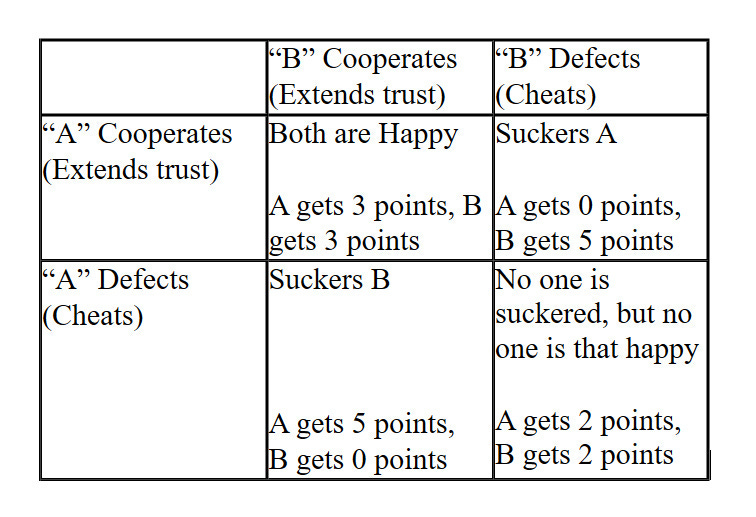
Social scientists quickly created a generalized form of the prisoner’s dilemma that strips the story away and provides payoff points in the positive instead of the negative. It looks like this:
If we were to ascribe a second “story” to this payoff matrix, that better approximated our actual evolution, it might go something like this:
Suppose two early humans lie down next to each other in the Serengeti for a night. They have the option of being friends or enemies, and neither knows which option their neighbor will choose. If they both extend the hand of trust and doze off next to each other unguarded, they both sleep soundly through the night and wake up well rested with all their possessions intact (let’s say 3 points each in our game). If one of them however decides to “defect” from this relationship of trust and exploit the other’s gullibility by waiting until he is asleep and then stealing his bow and arrow (and maybe even slitting his throat), then he literally makes off like a bandit (5 points for the bandit and 0 points for the sleeping victim). Of course, if both cavemen defect and lie awake with plans to attack each other in the night, then 1) Neither can steal each others possessions, because they are both on guard, but 2) Neither gets any sleep because they need to keep one eye open (let’s say 2 points each)
If both A and B cooperate then they both get 3 points each.
If A Cooperates and B defects then A gets suckered and gains 0 points, but B cashes in and gains 5 points
If A and B defect , then they both get 2 points each
Of course these numbers are a rough guide. A night of sound sleep and peace of mind might be worth more than 3 points, getting suckered might not be as low as 0 (he might only take a few arrows and leave you in perfect health) or perhaps mutual defection leads to a fight and you both incur serious injuries which would score lower than 2. Other situations will have different payoff matrices: If you throw a private potluck with a neighbor and you both “defect” by pretending to forget your dish in the hopes of scoring a free meal, then you are both left with nothing at all to eat (score of 0). If you opt to “defect” from the baseball league regulations and take steroids, your home run tally might only be mildly raised (4 points), but if everyone secretly takes steroids, your tally will merely be average and you’ll all suffer the side effects of the steroids (1 point).
What’s important to note when looking at the payoff matrix is that:
If we add up the numbers in each box, the mutual cooperation option will always be the highest number (in the generalized form it’s, 3+3 =6)
2) The highest individual score is earned through defection (in the generalized form, 5)
This is the mathematical illustration of a non-zero sum relationship. It makes the modest assertion that 2 people can do better if they cooperate (but both risk getting burnt), while admitting that one person can get ahead if he/she defects (and the risk is less).
The very fact that one can get ahead by defecting seems to confirm the suspicion that Darwinism selects for selfishness. For if we “always defect” in the above example, our outcomes in any given interaction will be either 5 points or 2 points (an average of 3.5 points) If we “always cooperate”; extending the hand of trust blindly to everyone, our outcomes will be either 3 points or 0 points, an average of 1.5 points. So at first glance, cooperation appears to be an inferior strategy, and as such, it seems unlikely (even impossible) to evolve in the cut throat world of evolution.
But humans have something that makes a significant change to the playing field: Memory. In the hunter gatherer villages in which we evolved, we ran into multiple people on multiple occasions, sometimes interacting with one individual one or two hundred times a day.
We remember who cheats us. We get wise to defectors and refuse to extend our trust, creating endless streams of mutual defections. Obviously, organisms locked in relationships of mutual cooperation are going to fare better. This is Trivers’ basic argument: That reciprocal altruism (mutual cooperation) evolved because it benefited organisms more so than mutual defection (competition).
But is this the optimum strategy? It seems to depend on the strategy of your neighbors. If everyone evolved to be a “dove” (prone to blind cooperation) then a single “hawk” (prone to exploitation) could easily storm through a village and exploit them all. Hawks would multiply and eventually, we’d be right back to where we started. So maybe there is no evolutionary stable optimum strategy – maybe the population ebbs and flows between hawks and doves? That’s possible, but it seems more likely that every human has evolved some capacity for cooperation and competition and doles them out according to some conscious or subconscious algorithm that maximizes their own individual “score”.
Figuring out the nature of this subconscious algorithm was no easy task. To do so, scientists needed to run a few “practice rounds” of evolution. The result would give them unprecedented insight into the moral nature of man. But at the time the mathematical calculations required to run a few “practice rounds” of evolution with large populations and hundreds of interactions per day were too difficult to attempt.
Enter the second major scientific advancement in the 1970s that led to the acceptance of reciprocal altruism as a viable theory for the evolution of kindness and cooperation. It was not one of philosophy or theory. It was one of technology: The computer. For the first time in history, massive calculations could be carried out in the matter of seconds. Millions of years could be condensed into a brief moment. And, combined with the new science of game theory, we could allow competing moral strategies to “duke it out” in a game of survival of the fittest and find out which one would win.
Computer Simulation and the Evolution of Cooperation
This is just what Robert Axelrod and William D. Hamilton did in their landmark article “The Evolution of Cooperation” written in 1981. They decided to let various programs, each employing different cooperate/defect algorithms duke it out in a generalized “prisoner’s dilemma” type game. They invited a number of his research associates to submit various strategies with differing algorithms, with the goal of achieving the high score in this virtual world. These programs would interact with each other 20 times every round. Each time they had the opportunity to “cooperate” or “defect” and were paid off according to the generalized prisoner’s dilemma matrix listed earlier in this chapter. At the end of the round, the programs were allowed to “reproduce” in accordance to their success; the highest scorer was given a proportionally higher number of copies of itself in the next round, and so on. Thus, they could then watch the population change over time and see if an optimum strategy began to dominate the gene pool after hundreds or even thousands of generations. The game was called the “Iterated prisoner’s dilemma” (now often referred to as IPD)
The “Always Defect” hawk was one the programs, so was “Always Cooperate” dove. Others submitted programs that would try to lull their neighbors into cooperating, only to surprise them with a defection every now and then to cash in on big points. Some programs were “skeptical” (it took a lot of cooperation to convince them to cooperate) others were gullible (It took a lot of defection for them to stop offering the helping hand). It was a panoply of twisted and complex algorithms, each one trying to outwit the other. If there was an “optimum” strategy, evolution would find it. Run enough iterations and eventually one program would come out on top.
But at the end of the day, when the contest was finally run, the simplest algorithm won. It was just five lines long. It was called Tit-for-Tat.
Its logic was simple. When Tit-for-Tat met a new program, it’d offer the hand of cooperation. After that, it’d offer whatever its neighbor offered on the previous round. If it was given cooperation, it’d offer cooperation in the next round. If it was given defection, it’d defect until the other program “made nice” and cooperated again, at which point it’d once again offer the hand of cooperation. This program benefited from mutual streams of cooperation from the “nice” programs and guarded against being suckered too often from the “mean” ones.
Not only did it come to dominate the population after a couple hundred generations, but it proved to be an evolutionary stable strategy (or “ess”) This means that there were no new strategies that could exploit it and reenter the population. If you added an “always defect” hawk into the population, it wouldn’t take long for the Tit-for-Tats to recognize this bad apple and refuse to cooperate with him anymore. (Interestingly though, once Tit-for-Tat controlled the entire population, an “always cooperate” gene could, in fact, flourish, provided there were no other more hawkish genes making appearances… more on this, and a discussion on variations of the Iterated prisoners dilemma that take into account public and private acts, reputation, proximity and communication in appendix B)
So it was, 120 years after Darwin first suggested that our moral impulse could have evolved much like our physical bodies had, someone had a viable working model to show how it could have happened. This was the first accurate picture (albeit an over simplified one) that described the human (and animal) moral impulse. Our natural inclination is to make friends with nice people (cooperators) and make enemies (or at least avoid) “mean” ones (defectors). That seems obvious, but showing that friendship and generosity is at least half of the equation included in the optimum strategy is nothing short of astounding. For the optimum strategy is what evolution selects by default. This is where things “fall” if left to random chance. According to this theory, Love (and hate for that matter) are the inevitable results of organisms with memory interacting. Tit-for-Tat is the low ground that water will find if it runs down the mountain side. It’s where a river eventually forms, one that appears to be “designed”
Of course all this is an oversimplification. There is no “Tit-for-Tat” gene in our DNA. Humans aren’t computer programs. If we were, tit for tat would work perfectly and no one would ever defect. As it stands though, there are plenty of ways the equation can go wrong. This is because our behavior is ultimately determined not by digital ones and zeros but by the analog of emotion. If we humans follow a strategy that resembles tit-for-tat, we do it simply because we feel like doing it. Evolution uses emotion to motivate behavior. Cooperation breeds affection and trust, Defection breeds anger and suspicion. And after hundreds of thousands of years of evolution these emotions have become even further refined. There are different “qualities” of affection as well as different brands of anger. In fact, if we get really specific we can identify a corresponding emotion for every possible permutation of the prisoner’s dilemma’s matrix.
When someone cooperates with us, we feel gratitude (and hence, obligation). And as you might expect, the amount of gratitude we feel corresponds with the amount of help bestowed upon us. This is our subconscious keeping “score” in this game of Tit-for-Tat that evolution plays. We might repay someone opening a door for us with a smile, but when someone helps us load the moving truck we might feel obligated to cook them a meal. It’s an emotion that is so built into our being that it can at times become burdensome. How often do we reject help, or refuse to let someone pay for dinner? The premise is that we are being kind, but the serendipitous byproduct is that we escape the feeling of indebtedness.
The second emotion governing reciprocal altruism occurs when someone needs our help. In this case we feel sympathy (and when we help them, we feel pride). Again, these emotions are quantifiable. The greater someone’s plight, the greater sympathy we feel. The more effective we are at helping them, the more our heart swells with pride. Of course, it’s interesting to note that we expect gratitude in return. How many times have you heard someone grumble “He didn’t even say thanks”. The utterance of the words “thank you” does nothing to our bottom line in evolutionary terms, however it’s an important acknowledgment that service has been rendered. It’s a receipt if you will. An admission of indebtedness, or at least a declaration that things are starting off on the right foot and you can expect cooperation to follow; quite useful in this game of reciprocal altruism.
When someone cheats us we feel hostility and anger (and a catharsis of retribution when we punish them) Once again, this emotion is quantifiable. Cutting someone off in traffic might yield a dirty look, but breaking into a home might get one shot. One need only look to the countless “revenge fantasies” of Hollywood action movies to see how ingrained this emotion is in our psyche. The cliché plot is always the same. An evil villain subjects our vicarious hero to some great injustice, but by the end of the movie, the hero prevails and the villain gets his due – often in a spectacular death. It releases so many “feel good” endorphins into our brain we pay hard earned money just to watch it. There are, of course, evolutionary advantageous qualities in this desire for retribution. By punishing those that defect against us, we not only avoid exploitation, but we “train” them to behave.
But there are lurking dangers here in the dark side of humanity. “Punishing” someone erodes trust and two individuals run the risk of getting caught in a never ending train of mutual defections. Something of this sort happens when two countries engage in an arms race. In the 1980s The US and the USSR sat down at the table again and again to try to put a halt to the massive weapons build up. Mutual cooperation would have allowed us both to spend money on more important things like education and infrastructure. But if one side defected (built missiles in secret) they may have gained an upper hand with consequences too terrible to imagine, so neither side dared offer the hand of cooperation and reduce their stockpiles, instead we both just kept building bombs – locked in an endless stream of mutual defection. In the end we built so many that we could blow the world up 100 times over. Just think of what good we could have done with the time, effort and resources that went into building such weaponry. All we needed to do was trust each other. Sometimes, that’s not an easy task.
To make matters even more difficult, these endless streams of mutual defection tend to escalate. This is due to the fact that the punishment, since administered in a state of hot headedness, often is greater than the crime. There’s an old parable about a family that visits a neighboring city to buy goods at the market. The family’s small boy reaches for a grain of rice and the shopkeeper slaps his hand. The father gets upset and instinctively shoves the shopkeeper. The shopkeeper’s friends ambush the father and beat him. That night, the extended family of the beaten father sneaked into town and set the shopkeeper’s store on fire. The next night a band of merchants band together and raid the father’s village, soon two towns, and then two nations are at war, all over a single grain of rice. Hyperbole to be sure, but it illustrates the phenomenon of “escalating tensions” that seem to grip nations like Israel and Palestine.
The dangers of getting caught in a never ending stream of mutual defections is so great that programmers have finally created an alternate version of Tit-for-Tat that has proven to be superior. It’s called “tit-for-tat plus forgiveness”. When locked in a stream of mutual defection, this program will suddenly offer the hand of cooperation every now and then just to test the waters and see if its neighbor would like to play nice. Of course, this clever line of code is built into humans as well. Surely we all notice how “time heals all wounds” and that the great offense one waged against you last year, is “water under the bridge” when you meet again. It’s especially easy to forgive if the one who waged the original offense comes at you in a conciliatory manner – begging forgiveness if you will. This, of course, happens all the time. Apologies might be voiced by two women through an hour long conversation or symbolically represented by two men with an invitation to toss the football (my apologies for the sexiest stereotyping). We should also note that there are gruffer, less intelligent animals than human males that routinely ask forgiveness – we’ve all seen our dogs put their tails between their legs and cower when they’ve clearly done us wrong.
The emotion we’re talking about is guilt. It’s the feeling brought about when you’ve defected in a relationship. Once again, this emotion is quantifiable. The more egregious your transgression, the more guilt you feel. Not only that, but studies have shown the more likely you are to get caught, the greater “guilt” you’ll feel. This makes sense – by admitting fault before getting “caught”, you save face – you appear to be a more honest broker. Yes, you screwed up, but at least you admitted it. Guilt pushes us into that conciliatory manner that begs forgiveness. It helps us avoid endless streams of mutual defection.
There’s no surprise that guilt plays a large part in many religions. “We are all sinners” is the central idea of much of scripture.
Christianity suggests we not only seek forgiveness, but dole it out as well. Such safeguards against endless streams of mutual defection are front and center in Christianity. In fact, one might say this is what religion is; a system designed to facilitate reciprocal altruism. The famous passage from the book of Luke reads:
But I tell you who hear me: Love your enemies, do good to those who hate you, bless those who curse you, pray for those who mistreat you. If someone strikes you on one cheek, turn to the other also. If someone takes your cloak, do not stop him from taking your tunic. Give to everyone who asks you, and if anyone takes what belongs to you, do not demand it back. Do to others as you would have them do to you.
—Luke 6:27-31. NIV
These wise words extol the power and value of forgiveness, but few come close to approaching this ideal. That doesn’t mean humans aren’t capable of acts of grace. We’ve seen parents in the courtroom forgive the killer of their children as he goes off to life in prison. But this is perhaps as much for their own benefit as it is for the killer. By forgiving others of injustices we free our minds of the overwhelming hate and need for retribution so we can get on with our lives. If they really were following the “turn the other cheek” school of thought they’d forgive the killer by removing the sentence and setting him free (and if we want to adhere to a more literal interpretation, they’d offer themselves as the next victims). It’s questionable this sort of forgiveness ever happens. Did one single American suggest we turn the other cheek to Osama Bin Laden after the 9/11 attacks? Grant him clemency? Meet with him on diplomatic terms, shake hands… hug?
Of course there is another factor here that acts as an obstacle to forgiveness here. It is the fact that so few of us were directly affected by the events of 9/11. Our rage is on behalf of the victims, not ourselves. This is yet another evolved trait that solidifies tribes and builds teams of cooperators. We stand much to gain if we make an ostentatious show of our rage when a neighbor is victimized, because we desire the same “you’ve got my back” sympathy when we fall victim to some transgression. The parents may forgive the killer of their child, but it’s unlikely the parent’s closest friends ever will. In fact, culture dictates that it’s not even their place to do so. This, more than anything, is at the root of militant patriotism. We are stronger standing together and if any of us shows weakness, it’s a crack in the façade that can betray the entire group. Here emotions may run stronger than logic. The cool headed Abe Lincoln suggested the most effective way to destroy our enemies was to befriend them. Yet it offends our desire for retribution to do so. It could also be said that it rewards violent behavior. In fact, it bears mentioning that Lincoln only said these words after the south was all but destroyed and it was time for reconciliation.
If we remove all emotion from the equation however, it’s possible to at least form an argument that explores the possibility that more lives could have been saved if we forgave Bin Laden after 9/11 instead of invoking war. Of course, most people are too offended to even consider such an option. They would literally rather die fighting. If there’s one thing humans are good at, it’s killing each other. Our species is still in its infancy and we’ve already developed the technology to kill everyone on Earth. It remains to be seen if we will.
Reputation
One thing Alexrod’s tournament did not include was communication. It’s thought that humans evolved in tribes or villages of 80-200 people. In groups of this size, the acts of bad apples are widely broadcast, so one simple defection can lead to getting the cold shoulder from everyone you know. Likewise, one act of heroic bravery can earn the immediate trust and affection of all those made aware of it. With this in mind, we can begin to account for why soldiers give their lives in war — an act that seems to run counter to evolutionary psychology.
This is because giving one’s life is usually more accurately defined as “risking one’s life”. If there is a “bravery” gene, or collection of genes, the basic evolutionary calculus requires that those that survive acts of bravery raise their reproductive success to more than make up for the reproductive potential lost by those that sacrifice their lives.
We might all run into a burning building, but most of us will stop deep in the bowels of that building when we discover our path is blocked by fire. True, some individuals might cross through burning flames, subjecting themselves to disfiguring and life threatening burns to save someone… however such outstanding bravery is typically limited to saving a blood kin.
But what about soldiers who jump on grenades to save the platoon? First, it bears mentioning, that in many instances like this it may be reasoned that the chances of dying were very great no matter what action was taken. But secondly we need to note that these are often split second decisions. When more time and/or options are presented to an individual, the irrational mind loses favor. Fewer people would march through 30 seconds of flames than jump on a grenade, and fewer still would donate their own heart (and thus their life) to a patient in need of one.
Perhaps the most relevant fact is that grenades (and other forms of firepower) are a brand new addition to the evolutionary environment. The genes in an individual that cause such wild displays of self sacrifice and bravery evolved in a distant past where it would lead them not to jump on to grenades, but perhaps to lead the charge into battle. Here the prospect of death is not so certain, and once again, it’s clear the payoff in reputation, social status (even, perhaps number of wives) of such acts of bravery are worth the risk of failure.[ Some would argue there is a mild form of group selectionism going on here. Group selectionism cannot account for the evolution of any single trait, but some believe it can help “push” evolution along in a particular direction once that trait has been established. And in the case of war, one is likely to share more genes with their fellow tribesmen than they are with neighboring tribes, so dying for your tribe may still act as a net gain for some of your genes if your actions lead your tribe to victory.]
That is not to say men act without trepidation – the genes for fear are alive in all of us. As we mentioned before, humans are perfectly capable of simultaneously experiencing multiple emotions. Fear for one’s life, desire for glory and a reputation of selfless bravery and a devotion to one’s friends, tribe, or nation.
Alliance building is common among many social mammals and humans are no exception. It’s difficult to think of a better way to cement an alliance and gain friends than by advertising that you would jump on a grenade for your friends. With this sort of loyalty it’s easy to see how gangs turned into tribes and tribes turned into nations.
Society
Thus far, we’ve spent a great deal of time pointing out the dangers of getting caught in mutual streams of defection. But there is a flip side to this danger. It’s just as easy to get caught in mutual streams of cooperation with each side continually raising the stakes: Your neighbors invite you to dinner, you clear their drive with your snow blower the next week. They share their season tickets to the playhouse with you. You help build the addition to their house. Before you know it, you’re the godparents of their children.
This sounds wonderful, but it actually gets better. The incredible beauty about reciprocal altruism is that, the more cooperators we add to the equation, the bigger our rewards. Two can accomplish much more than one, Three can accomplish much more than two and so on.
Things get really good when a village of friends forms. A band of Tit-for-Tats in the middle of a thousand other Tit-for-Tats needn’t even worry about retaliation or punishing its neighbors, in fact, it can just extend the hand of cooperation randomly, because it knows it’ll be met with more cooperation. It doesn’t need to play any defense at all, because it doesn’t even think about being exploited. We sleep better at night knowing our friends aren’t going to kill and rape us. In the best situations, when trust extends to the entire group, we need not even keep score with other individuals anymore because everyone is so helpful. We know even strangers have our back. When this happens, a sort of culture begins to develop in which reciprocation may not necessarily come from that person we helped — it may well come from another stranger. For instance, when you find a wallet on the street and return it to its rightful owner, you’re not expecting payment of reciprocation from the owner of the wallet, you’re expecting that some day, when you lose your wallet on the street, some stranger will find it and return it to you. In this way, good deeds eventually come back to you. You’re doing your part to create a society that would want to live in. You’ve gone beyond the individual reciprocal relationships and entered into a reciprocal relationship with all of society.
In fact, if we apply our gift of cognition to our natural instincts it’s easy to see how tribes can turn into nations. And if communication between nations can “shrink” the world into a digestible size, nations can unite to become one humanity.
The beauty and logic of this “moral reasoning” was readily apparent to Charles Darwin. Consider the following words of wisdom he offered around 1882:
As man advances in civilization, and small tribes are united into larger communities, the simplest reason would tell each individual that he ought to extend his social instincts and sympathies to all the members of the same nation, though personally unknown to him. This point being once reached, there is only an artificial barrier to prevent his sympathies extending to the men of all nations and races
– Charles Darwin
This realization that if everyone does their part, we all reap the benefits is a game changer. Instead of paying everyone back, sometimes you just pay it forward. It’s an exponential expansion of the power of reciprocal altruism, and it’s one of the most beautiful, some would say the MOST beautiful, quality of humanity: The fact that we are more together than we could ever be alone. It’s a phenomenon that feels magical. It’s so intuitively backwards; that by serving others we all come out on top! It’s a concept so good, beautiful and true that it serves as the basis for most religions. It’s not just similar to the message of Christianity… this is the message of Christianity.
Our common instincts are the reasons the atheist professor and the Christian pastor both run to the aid of a child who falls on the playground, but it is their shared cognitive conclusion that leads them both to return the wallet they found on the ground to its rightful owner. They may have taken extremely different paths, but they end up reaching the exact same point. They’ve reached the “Good, Beautiful and True” core of life.
This is the “middle” where I suggested atheists and believers can meet.
But before we get there, we must overcome a few more obstacles. For society is not the utopia we’ve described in computer simulations. There are a couple of wrenches thrown into the equation.
The Limitations of Tit-for-Tat
There are two huge differences between the computer simulation in which Tit-for-Tat thrives and real life:
1) Appearing to be a selfless giver can gain as much reciprocation and favor as actually being one. For this reason, we tend to be more concerned with our reputation than our actual deeds.
In earlier arguments, we suggested our desire to earn a good reputation kept our morality in check. Unfortunately, reputation is so important that people often try to inflate it – not only consciously in front of others, but subconsciously in our own minds. We keep score of who owes whom what, but we constantly tweak the books in their favor. We tend to take more credit than we deserve and deny blame when it ought to fall on our shoulders.
Axelrod’s tournament did not allow for reputations to develop amongst the various algorithms. To do so, he would have had to allow the programs to communicate with one another. They would be allowed to vouch for friends and warn others about cheaters (perhaps even lie). Also, it would better reflect reality if some events were public (appearing under the direct observation of some programs) and other events private (appearing under the observation of only one (or even none) of the other programs. If this were the case, is there any doubt that programs would be on their best behavior in public, and perhaps more devious when no one was looking?
2) The second major flaw with Tit-for-Tat is the fact our affection for one another dissipates the farther away we get from our inner circle of friends. This makes perfect sense evolutionarily speaking. For the less likely you are to see someone again, the less likely they are to reciprocate our kindness.
You are likely to help your neighbors move. You are less likely to help a stranger across town do the same. Fortunately, humans have come up with a brilliant system to foster reciprocal altruism amongst strangers – it’s called money… more on this later.
The problem is most apparent in between populations that are genetically disparate. This is the cold calculus of evolution laid bare. Early humans had no knowledge of genes, so natural selection instilled in us a suspicion of those that look/talk/worship differently than we do. The less contact we have with another culture, the less likely we will engage in a stream of mutual reciprocation (and the less likely we will share genes) the more likely war becomes.
Once again, Axelrod’s computer simulation did not account for this. In order to do so, it would require the characteristic of proximity to be added to the equation. We’d need to create a virtual universe in which programs could move about and interact with whomever they pleased. Some would run into each other twenty times a day, others would rarely be seen. Some algorithms could be social butterflies, other’s loners. We’d no doubt start to see cliques form – each one growing larger and larger (much as human societies do).
Of course, proximity and reputation are very much intertwined. When you don’t know someone, you must rely on the advice of friends who do. Today’s societies are so large that anonymity breeds exploitation. This is, of course, why there is considerably more crime in big cities than there is in small towns. And why scams are more rampant on the internet than they are in person. Our sense of trust evolved in small groups. It is not entirely applicable to big city life.
It takes intelligence to see the futility of cheating others, and discipline to forgo short term gain to seek out long term happiness. In the next chapter we’ll explore how atheists and believers go about it.
The basic point of my last post was to show the instinctual and cognitive basis for our moral reasoning, and that absent any supernatural reward, moral behavior is logical.
The purely logical human returns their shopping cart to the cart corral because they know that what they lose in the effort of walking 20 extra feet is made up for in the convenience of having a parking lot free of carts rolling around and denting cars. They are able to imagine the society in which they’d like to live, and do their part to make it happen.
This is why they don’t toss their paper cup out of the window of their car. Even if they do not care about living in a filthy city, they realize others do, and they’d like to live in a society that respects the wishes of others (As they would like their own wishes to be respected). Of course, a scan of any street gutter will provide ample evidence that not all humans have the cognitive abilities to realize this. Or perhaps they just don’t have the ability to delay the instant gratification of getting rid of a cup to reap the more diffuse long term gain of a cleaner environment. Either way, our dirty street gutters are just more evidence that humans often need encouragement from the group to keep doing their part. Once a few bad apples exploit the system, the entire network trust begins to break down. It’s more difficult to return a cart to the cart corral when there are 50 carts strewn about the parking lot. Why pay into a system that’s not paying you back?
Let’s return to the lost wallet example. Anyone who’s found a wallet on the street surely knows it’s somewhat tempting to keep it.
The atheists resist this temptation for 2 reasons. The first is simply that being nice feels good. This is a gift from evolution. The second reason comes from the cognitive realization that they may lose their wallet someday, and if they expect it to be returned they must do their part in building a society of wallet returners (That means returning any wallet they find).
Whatever personal gain they may get from keeping the money will be offset by the small crack their act creates in the “trust and honesty” code of their society. The owner of the wallet will likely feel cheated and will himself be less likely to return any wallet he may find. This sets off a chain reaction of selfishness, and eventually makes life worse for us all. It’s not long until anyone who loses their wallet can just kiss it goodbye.
Returning the wallet has the opposite effect, it sets off a chain reaction of selflessness and cooperation. The owner of the wallet, happy to get the wallet back, feels he can trust strangers on the street. Society has offered him the hand of corporation, so as a loyal tit-for-tatter, he is more likely to extend a helping hand to another stranger, who is more likely to do the same. Society becomes better for us all and no one needs to fear dropping their wallet, because we know it will be returned, so in the long run, we really are repaid for our selfless act. Society itself reciprocates with us. It’s a phenomenon that borders on magic.
Karma
The Eastern religions call this phenomenon “Karma”, and for them, it does more than border on magic, it IS magic, or perhaps “supernatural” is a better word. They see it as an actual force that somehow keeps track of your indebtedness or generosity to society. Giving the wallet back (or not throwing the cup out the window) generates “good Karma” and makes you more likely to reap benefits from some other situation. This may seem Pollyannaish, but according to the logic of the atheist argument, it’s actually an accurate picture of reality. This is, of course, why the idea of Karma persists. Even if your action goes unnoticed and unrewarded (which is unlikely) you’ve done your part to create a better society… which (in theory) will ultimately reward you . By upholding your share of a trustworthy society to maintain that chain reaction of endless corporation every individual has with society as a whole, maximizing the number of non zero interactions and, in a roundabout way, benefiting yourself. That’s key — Karma is the metaphorical illustration of the fact that serving others benefits yourself.
Christianity
The Western Religions have taken this idea one step further and personified Karma. They believe in more than a mysterious force that keeps track of your good deeds, they believe in a mysterious intelligence: Even when no other humans can see you in that abandoned alley, they believe there is one all knowing and all powerful being that can always see you… and he, (or “it”) can and will reward or punish your for your actions – just as Karma does. We’re talking, of course, about God. By transforming the creator God present in almost all cultures into a moral judge that can reward or punish believers much like karma can, Yaweh became more powerful and relevant than Zeus and Apollo. Like Karma, today’s God will take note of your deed even if you return the wallet anonymously. God sees all. He is the ultimate partner in reciprocal altruism. He picks up the slack everywhere our natural instincts might fail.
In fact, God corrects the weaknesses of Tit for Tat so well, it’s tempting to suggest that humans designed it. This would be an ironic twist on the “Argument by Design”. Instead of suggesting that humans are put together so well that they must have been designed by a God, we argue that the idea of God is put together so well that it must have been designed by us. Of course, it doesn’t seem fair to discount the theologians’ argument by design and accept the atheists’. But let’s look more closely at why we rejected the theologian’s argument. Scientists don’t dispute the fact that humans were designed, they just believe humans were designed by millions of years of natural selection… not an omnipotent creator. So, applying this logic to the atheist’s argument that God is designed by humans makes sense. It’s like admitting that no enterprising priest sat down and sketched out the idea of God start to finish as an elaborate ruse to fool the townsfolk, instead the idea evolved via natural selection. The idea of God literally throwing lightning bolts down from the sky has become extinct. The one that smites cities is dying out. The lack of utility of these ideas made it difficult for them to reproduce or be passed on via oral or written tradition. This is how the idea of God is honed as it passes on from one generation to the next, each year growing more and more appropriate to our needs and desires, and society’s most pressing need is to maximize reciprocal altruism, particularly when no one else is looking. This is exactly what the idea of God does: Consider these qualities:
He sees everything. Altruism is not self-serving if your benefactor doesn’t see it. Cheating doesn’t get punished if you act anonymously. God solves both these problems by putting eyes on everybody, all of the time.
There may well have been a preacher at some time and place who suggested God can’t see you when you’re indoors. It wouldn’t be long until thefts were rampant indoors. It’s a much more effective idea to suggest God can see you in all places, at all times, indoors and out, in fact, he even knows your thoughts, and he has little difficulty in keeping score of your good deeds. Thomas Paine once said “Reputation is what men and women think about us. Character is what God and Angels know about us”. The implicit suggestion: Act like you’re being watched at all times, that (and presumably that alone) will keep you in line. It’s a quick fix heuristic that’s simpler than trying to explain the ins and outs of our reciprocal altruistic relationship with society as a whole. It plays upon the existing importance of reputation in our brain to bring about a greater societal good. Could it be any clearer that these myths have evolved as an extension of existing impulses in the brain? That they fulfill what we cognitively know is right by framing it in a manner more palpable to our emotional instincts?
With this in mind, it’s easy to understand why Christians fear and loathe atheists. In the Christian’s eyes, the atheist is saying that there is no great rewarder or punisher that keeps people from exploiting the system. There is no magical Karma that keeps track of our good and bad deeds or our indebtedness to society. The Christian feels like without God, the whole system falls apart. It’s license to be hedonistic and exploit others without fear of repercussion. It’s much worse than suggesting God can’t see you when you’re indoors, Atheists are suggesting God never sees you… in fact, there IS no God! It’s like they’re whispering in kid’s ears to “go do whatever you want, no one will know and you can’t be punished.
But of course, there are repercussions – not only to your friends and acquaintances, but to society as a whole, and ultimately to you. The atheist knows this. There is still plenty of reason to return the wallet found in the dark alley. True, it takes a good deal of cognition and ability to see the big picture, but it’s plain to see that we must do our part if we expect to live in a society that we’d like to live in. The Golden Rule is self evident. All atheists are doing is removing the “supernatural” from the equation. To them, it’s the last “myth and metaphor” to be peeled away.
The second characteristic of God that meshes with our emotional instincts is that he has the ultimate power to reciprocate. In fact, he’s thought to be so capable of reciprocation that early humans offered “sacrifices” to him on a regular basis to remain in his “good favor”. This is yet another validation of just how ingrained “tit for tat” is in the human mind – how intense our need for remaining in good favor is. Thankfully, we don’t offer animal sacrifices anymore, but there’s something to be gleaned from the fact that religious people everywhere express copious amounts of gratitude to God. This is no coincidence. Gratitude has been honed by thousands of years of evolution to cement the bonds of reciprocation. And it’s been shown that humans offer the most gratitude to those in power, as they are capable of bestowing the greatest fortune on us in the future. So while we no longer offer sacrifices on the altar, we routinely “give thanks” before meals and other occasions. Failure to do so might offend the “giver”. For it certainly seems as though we’ve been given food doesn’t it? It’s just hanging on trees for us to pick and scurrying around forests for us to spear. Of course, with the knowledge of evolution in our back pocket, we realize that we evolved to exploit the environment that was present. (the environment wasn’t created for us – we adapted to it) And we also evolved a strong sense of gratitude to grease the wheels of reciprocal altruism. It’s so strong that it’s nearly impossible for us to experience some good fortune without giving thanks to somebody. Many a church service revolves around the idea of giving thanks as well. Gratitude is inherent in the very word “worship”. Songs are sung to celebrate the lord. Prayers are delivered on one’s knees – the ultimate sign of submission. The entire process a wild exploitation of our natural tendencies and evolved traits.
The third characteristic of God’s ability to reinforce reciprocal altruism is God’s ability to reward and punish us beyond our lives. This fixes a major flaw in tit for tat. Let’s face it, cooperating doesn’t always work out that well. We don’t always get the reward we were promised. Our fortitude is routinely tested. And if we are to stave off the threat of entering into endless streams of mutual defection, we’re going to need faith… faith that our good deeds will be rewarded, faith that other’s sins will be punished. Religion reinforces these two beliefs with such certainty that death itself isn’t an obstacle to carrying either out. After death, reward or punishment is as intense as we can possibly imagine. Of course, it’s also quite convenient that there are no eye witnesses to report back on the veracity of this promise. But in the end, this doesn’t really matter, for there IS truth in the idea that strict adherence to a moral code leads to heaven, only it’s not after death, it’s here on Earth. This is the ultimate reason the idea persists.
Good, Beautiful, and True
Three different belief structures, Atheism, Karma and Christianity, all leading to the same conclusion – that we ought to “Do unto to others as you’d have done unto you” And that if we all do this, we all benefit more than we ever could alone.
This is the common ground between Atheists and Theists.
It is the idea that love is stronger than hate, Peace preferable to war. That we ought to do unto others as we would have done unto us. These are the words both Jesus and Darwin preached.
The believer has reached it through intuition and tradition. The Atheist has reached it through logic and reason. But we’ve both reached the exact same place.
Go into any church of any faith and listen to what they are talking about. They talk about Love, Goodness, altruism, the brotherhood of man… you can feel it in the air. You experience God. God is the experience of love, but it is not the explanation. The steady sunrise of science has shed light the origins of love and understanding, but this does not dilute their effect. Are sermons that preach altruism and goodwill any less moving now that we know about the evolution of our moral instinct through tit for tat and logic of extending that moral instinct to strangers? I suggest it is MORE compelling now that we know the truth behind its origin and they have laid out the effect of its universal application. Knowledge is not the enemy. The explanation does not diminish the experience.
Imagine life is a roller coaster. We are just now working out the nuts and bolts and blueprint, the G-forces and friction coefficients. But no matter how much we know about the math and physics, it does not change the excitement we feel in our stomachs when we go over the first big hill. Science describes that feeling as the sudden removal of G forces on your internal organs brought on by achieving a sudden increase in downward velocity; we describe that feeling as “Wow!”
Science calls altruistic love an amendment of kin selection and pair bonding strengthened by the beneficial effects of reciprocal altruism that has evolved through natural selection. Religion calls it God. Does it matter what we call it? Is it not just as real both ways?
Isn’t the central axiom of Christianity: “God IS Love”? The word “is” implies reflexivity. Thus the two ought to be able to be used interchangeably… Love IS God.
But is it Supernatural?
Let’s face it, most Christians don’t think it’s the same both ways. In their heart they feel that “talking to God” is not the same as “talking to ourselves”. Even if loving your neighbors is provable in the court of scientific opinion to be an evolutionary stable strategy, there’s a certain comfort and certainty to know this command comes from something much greater than ourselves. Perhaps the evolution of love and morality was all part of God’s plan prior to the Big Bang.
Whether or not this is true is impossible to determine, but we can ask ourselves “What would this change if it were true”.
Some might suggest it would provide greater motivation for doing “good”. This opinion merely reflects an inability to see the big picture repercussions of one’s actions that we’ve gone over and over in the above chapters.
Others might suggest, however, that a God behind the Big Bang provides more solid footing for objective moral assertions. They might say that we are not merely trying to create a moral framework we all agree upon, but rather trying to “discover” one that’s already out there; that we are trying to “discern God’s will”. After all, science doesn’t seem to address this question. Even if it’s realized that mutual cooperation is the most beneficial path for any individual to pursue. There’s still some debate over HOW to best cooperate. What’s the best way to help our neighbors? Our intention to cooperate with our neighbors will do us no good unless we know what our neighbors really want (and need). Should we shower them with candy? That’d make them happy… until their teeth rot out and they get diabetes. If we catch our child using drugs should we discipline her with a stern punishment, or a concerned chat? How about letting gays marry? Abortion? The death penalty? The redistribution of wealth?
In short, “What is Good?” (and how do we know it? Does this require something supernatural?)
Philosophers and theologians have spent years trying to answer this question. Indeed, the mere fact that two humans can come to any sort of consensus regarding what is good at all is curious. But this is exactly what we do when it comes to the vast majority of issues facing us. Surely everyone agrees that it’s immoral to punch your neighbor in the face. In fact, Theologian C.S. Lewis suggested in his book, Mere Christianity, that this consensus alone is an indication that an “objective law” does in fact exist somewhere, and this is evidence of God, for only God would have the power and authority to create such a divine truth. According to this theory, any difference of moral opinion arises from the misinterpretation, or failure to recognize, or acknowledge this divine law.
Scientists suggest a simpler explanation: They suggest we tend to agree on what is good because we tend to agree on what we like. For instance, No one likes getting punched in the face. Humans, as a species, have evolved a common denominator of hopes, dreams, desires as well as fears, annoyances and grievances. We call “Good” behavior that which maximizes the former and minimizes the latter.
Of course, our initial desires might be incongruent with our neighbor’s. In fact, our selfish desires are almost certainly diametrically opposed. I might like to steal my neighbor’s wallet, and my neighbor might like to steal mine. How do humans tend to resolve such a disagreement? If history is any indication, we may well come to physical blows over the matter. I might readily accept a fair fight if I was larger than my neighbor, however I would be overlooking the possibility that he could easily buy a gun and gain the upper hand. No problem, I’ll hire thugs with machine guns, to which he will respond with a grenade through my window at night. It wouldn’t be long until we were engaged in an endless stream of installing security systems and constantly looking over our shoulders. This is the endless stream of mutual defections we talked about in the previous chapter. Fortunately, most people have the foresight to realize this and we develop a contract of sorts; one that says, “I’m not going to steal your wallet if you won’t steal mine”. This is our ultimate desire. It’s a win-win and a cognitive no-brainer.
This all important realization forms the basis of morality. It’s the agreement that our own happiness is no more important than our neighbors, and if we imagine it is, problems will arise. Thus, we agree to temper our own selfishness as long as our neighbor does the same, and, ultimately, we’re both better for it. It’s a tenuous “contract” that often needs reinforcement (hence the popularity of religions).
But this philosophy alone doesn’t completely solve the issue. In real life, most actions produce a myriad of consequences. An action that might help your neighbor, might hurt another. I might bring about happiness to a teen if I encourage him to follow his dreams… but if his dreams involve shooting up the school, then the encouragement he received would never be considered “Good”. It might be good if I help a single mother rework her budget so that she can afford to send her daughter to college, but if she now only buys bargain products from overseas companies that are made by child slave labor, then perhaps the ultimate result of my action was not so moral after all. Virtually every action we take has repercussions that ripple far and wide, and weighing the wants and desires of only those close to us is bound to leave us blind to larger indiscretions not so easily perceived. This is why, in the late 18th century, philosopher Jeremy Bentham developed an equation of sorts to help us clear it up: He stated:
“The ‘right’ or ‘moral’ action is that which causes the “greatest happiness for the greatest number of people.”
It’s a philosophy called utilitarianism. One of his younger students, John Stuart Mill, popularized the philosophy with the 1863 book Utilitarianism. In it he states:
“…actions are right in proportion as they tend to promote happiness, wrong as they tend to produce the reverse of happiness.”
So, using this philosophy as a guiding light, it would be considered “immoral” to punch your neighbor in the face, or steal his wallet, or burn his house down, and “moral” to offer him a kind word, help him shovel his drive, or give him a gift. But what about showering him with candy every day? Paying for prostitutes to show up at his door? Leaving free beer on the hood of his car?
It’s clear that we must iron out the definition of the word “happiness”. For it often feels “good” to do things that are, in fact, bad for us. Candy for dinner might not be a good idea. For the sake of clarity, let’s define “pleasure” as something that brings about immediate reward, no matter how fleeting it is or how damaging it could be to our lives, but use the word “ happiness” to indicate something considerably more fulfilling over the long haul.
Virtually every formal guide to happiness recommends the denial of fleeting pleasures in the search for a deeper, more satisfying sense of well being that comes from a sense of accomplishment and the establishment of relationships. As Jesus said, “If thou will be my disciple, deny thyself, take up thy cross, and follow me[ Matthew 16:24]”. Indeed, the abstinence from sex, drinking and gambling were hallmarks of the Christian life for centuries. Even today, strict religious households often seem to live by the mantra, “If it feels good, it must be bad.”
Other religions practice similar forms of self denial. Fundamentalist Islamic men dare not let themselves see any part of a woman, less they give into temptation. Most Eastern religions incorporate periods of fasting. Buddhism goes so far to state that the ultimate goal of life is the “cessation of desire”.
The trick, of course, is knowing what will bring ultimate happiness. A drug addict might want another hit of meth, but no one would say it’s good to provide him one. Why? Because we know better. That’s a catch phrase of the morally indignant isn’t it? “You should know better than to do that”. Socrates suggested that’s what morality was all about – knowledge. Everyone wants to do the right thing – the good thing, the trick is knowing what it is. For him, the secret to a moral life wasn’t “Deny thyself”… it was “Know thyself”.
These are wise words as well. For if we really want to understand what makes others happy, we need only look inside ourselves and ask the same question. So, when we find the wallet in the alley, we need to ask ourselves “What would I want to happen if someone found my wallet?” This is introspection. It’s the first, and perhaps most powerful, method humans use to determine moral opinion.
Methods of Moral Discernment
Introspection
Jesus preached introspection. His advice to “Do unto others as you would have done unto you” lies at the very heart of Christianity.
The value of this idea is obvious. When we introspect into our own feelings we realize we’d rather be greeted with a smile than a punch. We’d rather eat a good meal than have our food stolen, we’d rather have people open doors for us, than slam them in our face. Of course, we must remember to not confuse pleasure with happiness and take into consideration the long term implications of our desires and actions. We must also remember there are times that our desires will not be perfectly congruent with our neighbors. Just because like chocolate ice cream for dessert, doesn’t necessarily mean you will. Surely we all know how annoying it is for an overbearing mother or father to press us into things they assume are “best for us” when really they have no idea. This is where a second form of discernment comes into play.
Observation
This allows us to observe the results of our actions. I see your face screw up with disgust when I give you chocolate ice cream, so I might try giving you vanilla (or better yet, I’ll just ask you what flavor you want – as we all agree that we enjoy freedom of choice). Observation allows us to better meet the needs of our neighbors. When faced with a problem like inner city crime we might decide through introspection that these kids have too much time on their hands and that extra curricular activities might set them on the straight and narrow, so, being moral people, we decide to start a night basketball league. Now our introspection may prove to be spot on brilliant and show a marked reduction in crime, or it may miss the mark, and actually increase crime by increasing inter-team rivalries. The only way to find out is to actually observe the results; perform studies, gather data etc…
Nowhere is the value of observation more apparent than when crafting policy for controversial issues such as prostitution, the legalization of drugs, pornography or gay marriage. These complex issues illustrate the vast variety of human desires, and introspection is unlikely to yield any consensus regarding the “morality” of these actions. Consequently, observation becomes the sole instrument for intelligent discourse.
Of course, even if you have 20 studies that suggest the legalization of drugs will ruin lives. We still face the moral question of how much influence we ought to have over the lives of others. We know that smoking causes cancer, but millions have decided the pleasure outweighs the danger. Who are we to tell them otherwise? All we can do is limit the exposure of innocents to second hand smoke in public places.
Should we say the same for all drugs? Objectivists and Libertarians believe we ought to be absolutely free to follow our own wants as long as it doesn’t impede on our neighbor’s desires.
The real question then becomes, what impedes on society? Should we be required to pay for the hospitalization of heroin addicts who OD? If so, should we have some say regarding the legality of heroin? Would the legalization of drugs make it more likely for minors to become addicted? Should we allow slick marketing campaigns for marijuana that prove too tempting for the average citizen? We allow Casinos to tempt people into bad bets, and soft drink companies to tempt people with sugar water. At what point do we “save people from themselves”
There is one more method of moral discernment that can help us answer these questions.
The Acquisition of Knowledge.
Technically this is also observation, but the qualitative difference is that it involves second hand observation of the lessons and wisdom of experts. There are some things we can’t glean from introspection and observation of our immediate experience. When a fourteen year old is offered heroin at a party, he’s never experienced the effects of the drug, knows nothing about addiction, has never observed anyone experiencing symptoms of withdrawal. He is entirely dependent on school, parents and perhaps the church to guide the correct course of action. Without leaning on the wisdom of the experts of the past, we are doomed to repeat the mistakes of prior generations. So important is this knowledge that our nation has given parents near complete authority over youths up to 18 years of age. Contracts are not even valid unless signed by a parent.
Personal instruction by parents, teachers and preachers is not the only sort of wisdom we can acquire. The written word has allowed the work of particularly wise individuals to pass lessons on to millions at a time, be it through a work of nonfiction, a novel, a textbook, a religious text, a film or a play, or an internet blog. Today, we do not only have access to the minds of billions of others on Earth, we have access to the billions of great minds in the last 2000 years at our fingertips.
The astute reader will realize that cataloging of wisdom is, in effect, what religions are. The Bible was created as a codified collection of the most important written wisdom of the time. Every religion has a sacred text and, due to the common denominator of hopes, dreams, and fears among humans, the texts share many truisms.
Of course, the problem with relying on the acquisition of knowledge is that it’s not always correct. Just how often these religious texts hit the nail on the head and how often they lead people astray is a subject for great debate, but it seems to be one of the primary dividing lines between the left and right in this country. Those on the right tend to value tradition, especially religion. In 2008 exit polls revealed that 49% of McCain voters believed the Bible to be the literal word of God compared to a mere 8.4% of Obama voters.
So.. we have three weapons, introspection, observation and the acquisition of knowledge to discern what makes others happy… how to best fulfill our half of the tit for tat relationship, how to be good.
The Problems with Utilitarianism
For all the utility of Utilitarianism, it introduces an odd problem; how do we quantify “happiness for the most”. If one blindly adheres to a Spock-like logic by seeking a “net gain” of happiness, he or she may decide that it is “morally correct” to enslave, or even torture one innocent person in order to raise the overall happiness of 1000 others.
Why do we find this prospect so appalling? What utilitarianism seems to ignore is the concept of “justice”; something humans feel instinctively having evolved a tit for tat mechanism in our psyche. Consider the following moral head-scratcher thought up by philosopher Philippa Foot called the Trolley Problem:
A trolley is running out of control down a track. In its path are 5 people who have been tied to the track by the mad philosopher. Fortunately, you can flip a switch, which will lead the trolley down a different track to safety. Unfortunately, there is a single person tied to that track. Should you flip the switch
The mathematics of Utilitarianism doesn’t just allow you to flip the switch, it requires it, if you are seeking to raise happiness and lessen pain.
But consider this variation of the problem offered by Judith Jarvis Thomson:
As before, a trolley is hurtling down a track towards five people. You are on a bridge under which it will pass, and you can stop it by dropping a heavy weight in front of it. As it happens, there is a very fat man next to you – your only way to stop the trolley is to push him over the bridge and onto the track, killing him to save five. Should you proceed?
In both of the above cases, we are sacrificing one life to save five. But a solid majority of people are willing to flip the switch, but not push the man. Clearly there is something else going on in our heads other than pure utilitarianism. Granted, there are always a few logicians in the mix that are willing to push the man, if you find yourself in that camp, consider the following thought experiment once again provided by Philippa Foot:
A transplant surgeon has five patients, each in need of a different organ, each of whom will die without that organ. Unfortunately, there are no organs available to perform any of these five transplant operations. A healthy young traveler, just passing through the city the doctor works in, comes in for a routine checkup. In the course of doing the checkup, the doctor discovers that his organs are compatible with all five of his dying patients. Suppose further that if the young man were to disappear, no one would suspect the doctor.
If this offends you, you’re not alone. Philosopher Joshua Greene suggests humans evolved an aversion to mistreating innocent people. This is yet another indication that our emotional base is ruled by the tit for tat algorithm. It is a clear aversion to defection in the first round. So strong is this impulse that it overrides any utilitarian calculus. So there is, as C.S. Lewis suggested an innate sense of “fairness” that all humans possess. But it evolved rather than being divinely handed to us. In fact, our sense of fairness is so instinctual; it evolved before we even became human. Consider the following experiment done by comparative psychologist Frans De Wall with monkeys (not the more intelligent chimps)
Two monkeys are in cages side by side, happily performing tasks for cucumber slices. But when the monkey on the right begins to receive grapes (a favorite fruit) for the same task, the monkey on the left suddenly seems disenchanted with his lousy cucumber. The treat he was readily devouring only a moment ago is now so distasteful that he throws the cucumber slices back at his experimenter in anger. He would rather have nothing at all than endure such injustice.
Humans behave in a nearly identical fashion. Consider this clever experiment thought up in 1982 by Güth, Schmittberger, and Schwarze[ Güth, W., Schmittberger, and Schwarze (1982). “An Experimental Analysis of Ultimatum Bargaining”. Journal of Economic Behavior and Organization 3 (4): 367–388. doi:10.1016/0167-2681(82)90011-7]. It’s called “The ultimatum game”.
Two players are given a sum of money. The first player decides how it will be split, and makes an offer of some portion to the second player. The second player can accept this offer and take his or her share of the money or reject it, in which case, neither player receives anything. Typically, the game is played only once so that reciprocation is not an issue. There are many ways to play, the most common is to play with 10 dollars and anonymous opponents.
Purely rational behavior would suggest that the first player, being in total control, would take a large percentage of the money (maybe $9.99) and the second player, deciding that having one penny is better than having none, would accept their small share. Of course this never happens. The first player typically offers much more – often splitting the money 50-50, and the second player typically rejects shoddy offers of anything less than 20%, with some even rejecting anything less than 50-50. Apparently some people would rather sacrifice 4 dollars than suffer the injustice of knowing their opponent got away with 6.
Of course, the experiment is an artificial situation. In the villages in which we evolved, we seldom ran into anonymous people for single interactions. Thus reciprocation is always an issue, and our sense of “fairness” has been honed by hundreds by the interactions of ancestors for hundreds of thousands of years. It’s in our lifeblood. And we are quite careful about entreating upon the freedom of others.
But of course, we do entreat on the freedoms of our neighbors. Every day we make small infringements on the happiness of others simply by expecting them to stop at red lights so we can go. Part of living with others is the expectation that everyone will do their part or carry their weight. Fortunately we need not ask them to throw their bodies in front of speeding trains. Our requests are much less demanding, like requesting our roommate clean the bathroom. The method by which we dole out responsibilities such as this reveals much about our moral sense.